Sleep Cycles
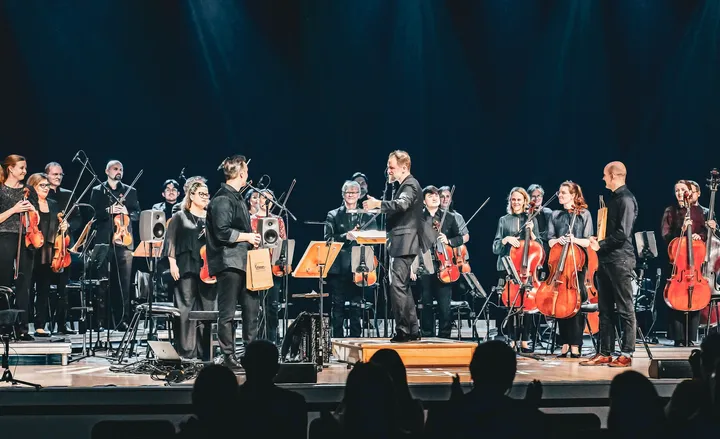
Harri Kuusijärvi, Tomas Djupsjöbacka and Ostrobothnian Chamber Orchestra, 2026
In 1714, Italian violinist Giuseppe Tartini discovered that when he played a double stop on his violin, he could hear a third, much lower tone. When the double stop was in tune, the third tone seemed to align as well. He called this tone a tartini tone. It is very peculiar: one can clearly hear it, but it cannot be recorded. If one records the violin double stop and uses a spectrum analyzer to look at the recording, at the place where the tartini tone is supposed to be, there is no trace of it. It is as if it exists in another dimension, unreachable by machines.
Actually not just violin, but all instruments can produce these tones, which in present day are more commonly referred as combination tones. On an accordion they are especially audible in the high register. However, an accordion cannot tune itself the same way a string player can tune a double stop. This means that the combination tones of an accordion land in very interesting places - between the twelve notes traditionally used in Western music.
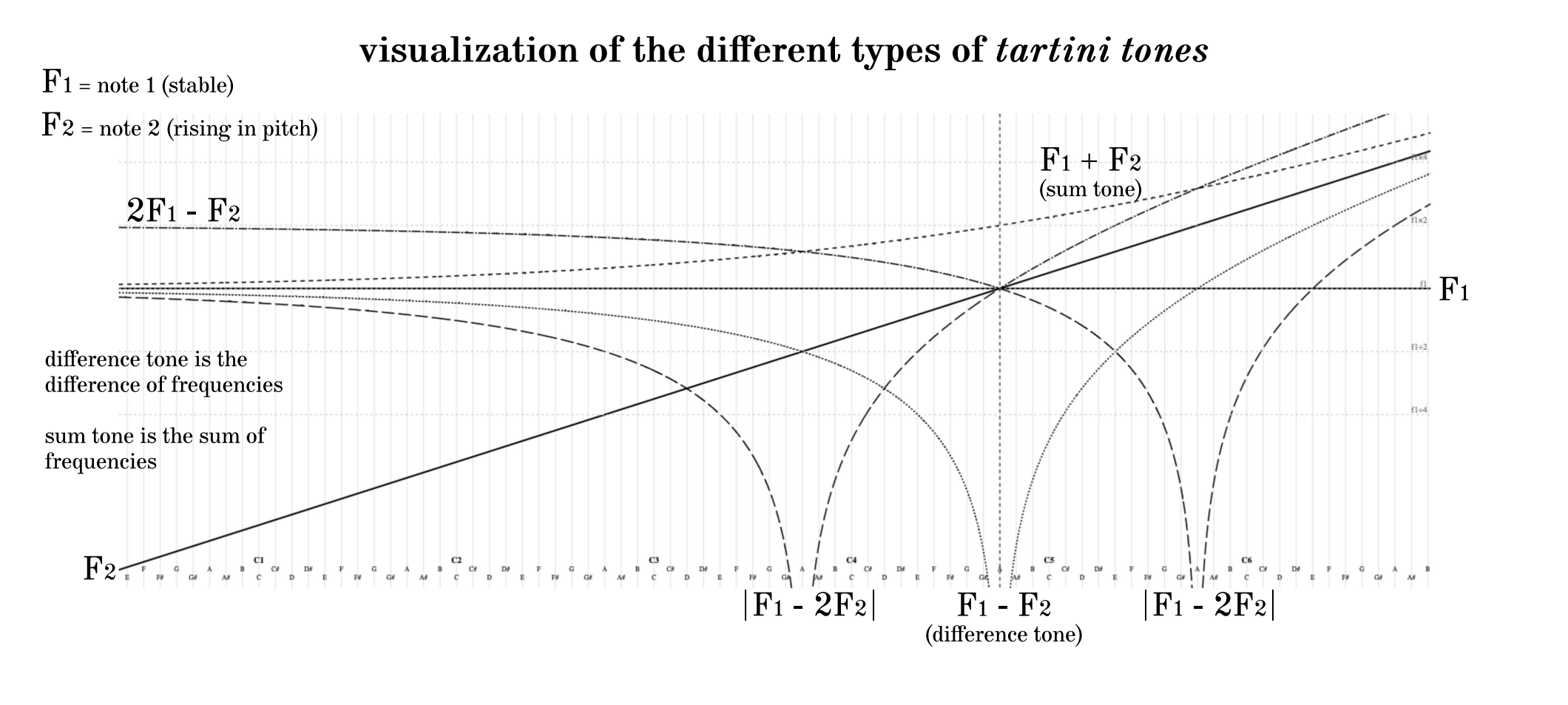
Even though a combination tone cannot be recorded, its pitch can be calculated. And there are actually many types of them: some of which cannot even be heard, but exist only in this imaginary mathematical dimension. However, they all follow the same simple principle, which Giuseppe Tartini discovered in 1714: two dissonant tones will produce a dissonant combination tone and two consonant tones a consonant combination tone. All string and wind players instinctively use this phenomenon to tune their playing: when a chord is in tune it feels resonant and pleasing. In this case the combination tones land on partials of the overtone series.
As a composer I became very interested in the combination tones of an accordion. I wrote a program that calculates them in real time from the notes played by the accordionist. Calculated tones can be then reproduced electronically - that way these imaginary pitches actually become real notes, producing very strange harmonies. Simple tonal chords and melodies turn into mysterious clusters of microtones and overtone-like scales that seem to change direction for no apparent reason. These combination tones seem to blend together with the original notes in a very natural way, resonating together beautifully. However, this resonance is very different from the traditional, justly tuned resonance.
I wanted to use also the string instruments to produce these so called tartini tones. After some thought, I decided that approximating them to the closest sixth tone would have the ideal balance between accuracy and readability. I hope that, just as traditional 12-tone notation is ultimately tuned by ear, these tartini tones will also be tuned by listening for the best resonance. These resonances can at times be very strange, but I wish that this strangeness could be embraced - and even enjoyed. Most of the time in this composition, the accordion has the same harmonies as strings, so that it can be listened to on its own as a reference.
Performances:
Feb 20, 2026 | Snellman Hall, Kokkola
Ostrobothnian Chamber Orchestra
Harri Kuusijärvi, electroacoustic accordion
Tomas Djupsjöbacka, conductor